

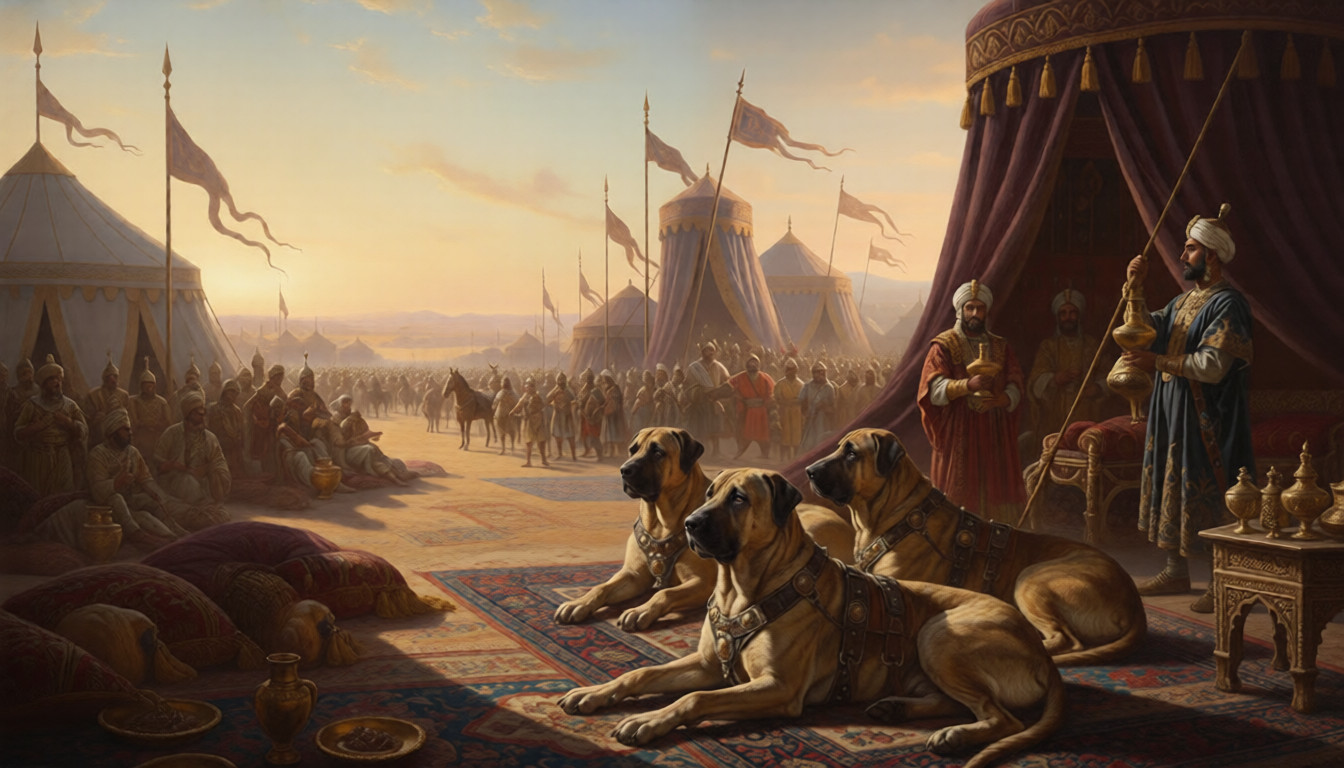
It is a humid dawn in 480 BC. The sun barely pierces the desert haze over the sprawling Persian camp. Xerxes I, the King of Kings, walks among his tents, his eyes sweeping across legions of soldiers, cavalry, and elephants. But there is something else, something that makes the army unique: the Indian hounds, massive dogs, fierce and disciplined, numbering so many that even Herodotus, the great chronicler, could not count them all.
“Of the women … and the concubines … no man can state any exact number, nor again of … the Indian hounds … which accompanied it, could any one state the number … by reason of their multitude.” — Herodotus, Histories VII.187
Imagine it: a line of muscular beasts stretching across the camp, their coats glinting under the first rays of sunlight, their eyes sharp, alert, ready to obey the call of kings. They were more than animals—they were warriors, companions, and symbols of imperial might.
1. Xerxes’ Army: Men and Beasts Alike
Xerxes I inherited the mighty Achaemenid Empire from Darius the Great, and he ruled not just with men, but with strategy, grandeur, and vision. In 480 BC, as he prepared to invade Greece, his army became a spectacle of ambition. Among chariots, infantry, and elephants, the Indian hounds were present—not just as pets, but as living instruments of power.
Herodotus’ astonishment at their number hints at a deeper truth: these were carefully bred dogs, trained for courage, strength, and endurance. They were the ancestors of what we know today as the Bully Kutta, large, muscular, and unwavering in spirit.
2. Guardians of the Persian Camp
These hounds did not merely march—they watched, guarded, and defended. Tents of royalty, treasure, and strategy were under their watchful eyes. Their very presence was an assertion: this army was not just men—it was an empire in motion, and the dogs were its silent, loyal lieutenants.
The Persian court had long prized hunting dogs for prestige and status. In the eastern reaches of the empire—the Indus Valley, now in Pakistan—these dogs were selected and bred for strength, endurance, and courage. They were warriors in fur coats, integral to the imperial fabric of Persia.:
3. Why These Dogs Were Legendary
What made these Indian hounds extraordinary? Consider:
-
Strength and size: Massive bodies capable of intimidating foes.
-
Discipline: Trained to obey orders in chaos.
-
Courage: Fearless in the face of war.
Even if they never drew a sword, these dogs carried an aura of dread across the battlefield. Imagine Greek soldiers pausing, not just for the army, but for the beasts accompanying it.
The Persian hounds’ story is not only about strength—it is about loyalty, vigilance, and the bond between man and dog, a bond that survives to this day in the Bully Kutta.
4. From the Indus Valley to the Persian Front
The origins of these dogs lie in the Indus Valley, the ancient cradle of martial canines. Today, this region is part of Pakistan. Before the 1947 partition, it was considered India—but the ancestral home of the Bully Kutta remains firmly tied to the plains and rivers of the Indus.
Here, humans and dogs forged a partnership: the people bred strength, courage, and endurance into their hounds, creating a line that would inspire awe even in the royal courts of Persia. From Ancient Indus Dogs to Modern Bully Kutta
5. The Legacy of Xerxes’ Hounds
These dogs may never have a named battle like Thermopylae or Salamis, but their presence was legendary. The Bully Kutta history is not about anecdotes alone—it is about living legacy.
Today, a Bully Kutta’s muscular build, unyielding spirit, and fearless stance echo the ancient Indian hounds that marched with Xerxes’ armies. Their courage, loyalty, and vigilance are not merely inherited—they are etched in millennia of training and culture.
6. Traits of Ancient Hounds vs. Modern Bully Kutta
Ancient Indian Hounds (Xerxes’ Army):
-
Massive size and muscle
-
Fearless, disciplined temperament
-
Likely brindle or solid coats
Modern Bully Kutta:
-
Broad, powerful head and jaws
-
Deep chest, muscular shoulders
-
High endurance, persistence, and loyalty
-
Brindle or solid coat patterns
-
Guarding, defending, and protective instincts
7. Conclusion: A Living Link to the Past
The Bully Kutta history reminds us that the past is not distant. In 480 BC, Xerxes I, King of Kings of the Persian Empire, marched into Greece accompanied by countless Indian hounds, massive and disciplined dogs that served as guardians, hunters, and symbols of imperial power. Nearly 150 years later, in 327 BC, Alexander the Great encountered similar dogs during his campaign in the Indus Valley, when King Sophytes presented him with 150 formidable hounds. Both rulers recognized their military value — from guarding camps to instilling fear on the battlefield.
Every time a Bully Kutta stands vigilant, loyal, or unyielding, it carries forward the legacy of those ancient Indian hounds — a living connection to the Persian Empire, Alexander’s conquests, the Indus plains, and modern Pakistan. Their story is more than history; it is a living narrative that connects the Persian Empire, the Indus plains, and modern Pakistan, and it continues to captivate anyone who admires courage in its purest form.