

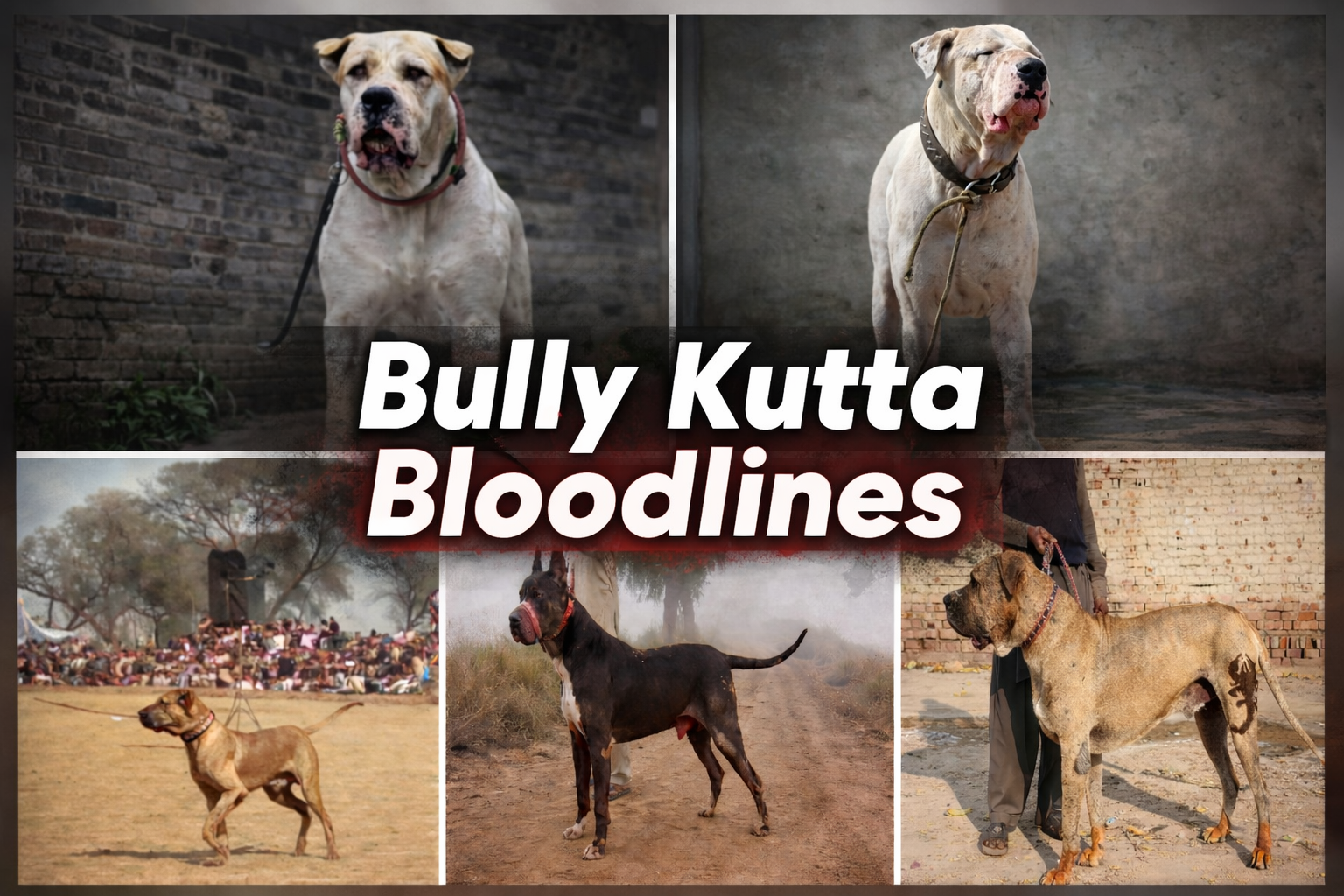
Bully Kutta Bloodlines: The 4 Principal Lines Explained (Beginner Guide)
If you search the internet for Bully Kutta bloodlines, you will find very little that reflects how the word “bloodline” is actually used in Pakistan.
Many websites discuss:
-
Ancient type
-
Nagi type
-
Asil type
-
Mastiff type
These are often presented as bloodlines.
They are not bloodlines.
They are types — visual classifications based on appearance.
And that distinction is where serious confusion begins.
This guide clarifies that confusion and presents — in a structured format — the four principal bloodlines from which modern Bully Kutta lineage discussions originate.
Much of this knowledge has historically been transmitted sina ba sina (person to person) within traditional mentorship structures in Pakistan. It has rarely been documented publicly.
This article organizes that oral knowledge into a clear, beginner-friendly framework.
To understand the Bully Kutta at a serious level, you must first understand its lines.
Bloodline vs Type: A Critical Distinction
Before discussing the four principal Bully Kutta bloodlines, we must establish clear definitions.
What Is a “Type”?
A type refers to phenotype — the external appearance of the dog.
Type includes:
-
Head structure
-
Bone density
-
Frame size
-
Coat texture
-
Height and overall build
When someone says “Ancient type” or “Mastiff type,” they are describing what the dog looks like.
This is visual classification.
It does not describe genetic lineage identity.
What Is a “Bloodline”?
A bloodline, in traditional Bully Kutta culture, is not defined by appearance alone.
It is defined by:
-
Genetic consistency
-
Inherited structural traits
-
Temperament profile
-
Nerve strength
-
Functional working tendencies
A bloodline traditionally revolves around a dominant male whose traits consistently pass into future generations. When that male reliably reproduces his structure, temperament, and working attributes, a recognizable line forms.
Over time, that consistency becomes a named bloodline.
In Pakistan, bloodlines are typically not named after individuals in the Western kennel club sense. Associating a person’s name directly with a dog can be culturally sensitive in Islamic tradition.
Instead, bloodlines are commonly named after:
-
A family or tribal identity
-
A caste identifier
-
A regional origin
-
Or the foundational dog itself
Bloodline identity is genetic and regional.
Type is visual.
Understanding this difference is foundational.
The Mentorship Structure Behind the Knowledge
Traditional Bully Kutta knowledge has been preserved through mentorship.
-
Ustad – Master teacher
-
Shikari – Traditional dogman
-
Shagird – Disciple
Through oral transmission, knowledge about breeding decisions, structural evaluation, inherited tendencies, and line consistency has been passed down.
This explains why detailed written documentation is rare — yet consistent recognition of specific bloodlines remains strong within serious circles.
Historical Naming of Bully Kutta Bloodlines
Bloodlines are often associated with:
-
Tribal or caste identity
-
Regional origin
-
Foundational dogs
For example:
-
Ranghar – A Rajput-associated Punjabi community known for martial traditions
-
Kharals – A historic Punjabi tribe remembered for resistance during the British Raj
-
Foundational dogs such as Batuna, Commando, or Lahori
These associations reflect where foundational breeding families and dogs emerged.
Performance-Based Bloodlines: A Comparative Framework
To understand bloodlines conceptually, a useful comparison is the American Pit Bull Terrier.
Historic APBT lines such as:
-
Red Boy
-
Jeep
-
Bolio
-
Tombstone
-
Jocko
-
Chinaman
were developed around dominant males that consistently passed working traits.
These lines were not defined solely by appearance. They were recognized because offspring repeatedly demonstrated inherited traits such as:
-
Endurance
-
Wind capacity
-
Structural durability
-
Intensity
-
Engagement style
Similarly, traditional Bully Kutta bloodlines were historically refined based on consistent inherited working reliability — not simply visual type.
This performance-based selection is what separates a bloodline from a visual classification.
Regional Foundations: How the Principal Bloodlines Formed (1980s–1990s)
During the 1980s and 1990s, transportation between rural districts in Pakistan was limited.
Breeding programs were largely regional:
-
Stud dogs stayed within villages
-
Females rarely traveled far
-
Geographic isolation reduced cross-line mixing
This created consistency.
When a dominant male in one district reproduced reliably, his offspring were bred locally. Over time, regional genetic identity formed.
These bloodlines were not artificially labeled.
They emerged naturally through:
-
Geographic concentration
-
Selective breeding
-
Limited travel infrastructure
That isolation is what solidified the four principal lines.
Modern Crosses and Combined Lines
Today, transportation and access have changed breeding dynamics.
Modern Bully Kutta breeding often involves cross-line combinations.
For example:
-
A Ranghar Wala female bred to a Jhedo Wala male
Over time, such combinations establish reputations of their own.
This mirrors what occurred in American Pit Bull Terrier history — such as the Red Boy–Jocko cross, known for blending endurance and structural balance.
However, before these modern blends became common, the four principal lines stood largely independent due to regional isolation.
That historical separation makes them foundational.
The Four Principal Bully Kutta Bloodlines
Most modern Bully Kutta lines trace directly or indirectly back to four foundational bloodlines:
-
Shair-e-Punjab
-
Ranghar Wala
-
Kharlon Wala
-
Jhedo Wala
1. Shair-e-Punjab Bloodline
“Shair” means lion. “Punjab” refers to the historic land of five rivers.
The Shair-e-Punjab bloodline descends from a foundational dog known as Shair-e-Punjab (“Lion of Punjab”).
-
Origin: Okara region, Punjab
-
Established: Late 1980s
-
Approximately 40 years old Bloodline
This line became recognized for its consistency and regional identity.
2. Ranghar Wala Bloodline
The Ranghar Wala bloodline traces to the Ranghar community of Punjab, particularly in the Okara region.
Ranghars are Rajputs historically known as a martial, land-owning agricultural tribe. The name derives from:
-
Run (battle)
-
Gurh (fort)
Grand Champion Ranghar Wala:
-
Bred and raised by Rao Akram
-
Co-owned by Rao Saeed Ranghar
-
Six-time National Circuit winner (1990s)
“Wala” means “owned by,” so Ranghar Wala translates to “Dog of the Ranghars.”
3. Kharlon Wala Bloodline
The Kharlon Wala bloodline originated in the Sahiwal region of Punjab in the 1960s, making it one of the oldest Bully Kutta bloodlines.
The Kharals are a historically significant Rajput clan remembered for resistance during the British Raj and immortalized in Punjabi folklore.
This line was founded by Turej Kharal and became the foundation of the famous Lalu Balochaan dogs — considered the epicenter of Bully Kutta breeding in Pakistan.
4. Jhedo Wala Bloodline
The Jhedo Wala bloodline is named after Grand Champion Jhedo Wala.
-
Bred, raised, and campaigned by Malik Kameer Jhedo
-
Origin: Okara region, Punjab
-
Established: 1990s
-
Six-time National Circuit winner
It is considered one of the most prolific and influential bloodlines in Pakistan.
Frequently Asked Questions (FAQ)
Are bloodlines the same as types?
No. Type refers to appearance. Bloodline refers to inherited genetic identity.
Do most modern Bully Kuttas trace back to these four lines?
Most traditional lineage discussions trace back to these foundational lines, though modern blended combinations exist.
Is documentation publicly available?
Historically, knowledge was transmitted orally through mentorship structures.
Can bloodline predict temperament?
It can suggest inherited tendencies, but environment and training significantly influence behavior.
Conclusion: The Foundation and the Future of Bully Kutta Bloodlines
The Bully Kutta is not defined by size alone.
It is not defined by head shape, bone density, or visual type.
Those are surface markers.
The real identity of the breed lies in lineage continuity.
During the late 1980s and 1990s, regional isolation allowed dominant sires to reproduce consistently within geographic pockets. Traits were fixed through concentration. Regional identity became genetic identity.
From that era emerged four principal bloodlines:
-
Shair-e-Punjab
-
Ranghar Wala
-
Kharlon Wala
-
Jhedo Wala
These are not casual labels.
They are the pillars of Bully Kutta lineage identity.
Modern breeding now includes cross-line combinations, and new blended lines are emerging. However, the majority of Bully Kuttas today can trace ancestry directly or indirectly back to these four foundational lines.
They are:
-
The genetic base
-
The historical anchors
-
The structural foundation
This article lays the groundwork.
In upcoming publications, we will explore:
-
Influential modern sires
-
Contemporary blended lines
-
How modern breeding reflects — or diverges from — original foundations
This is the beginning of documented clarity.
The foundation has been laid.
Stay tuned for deeper analysis — and share your feedback below.