

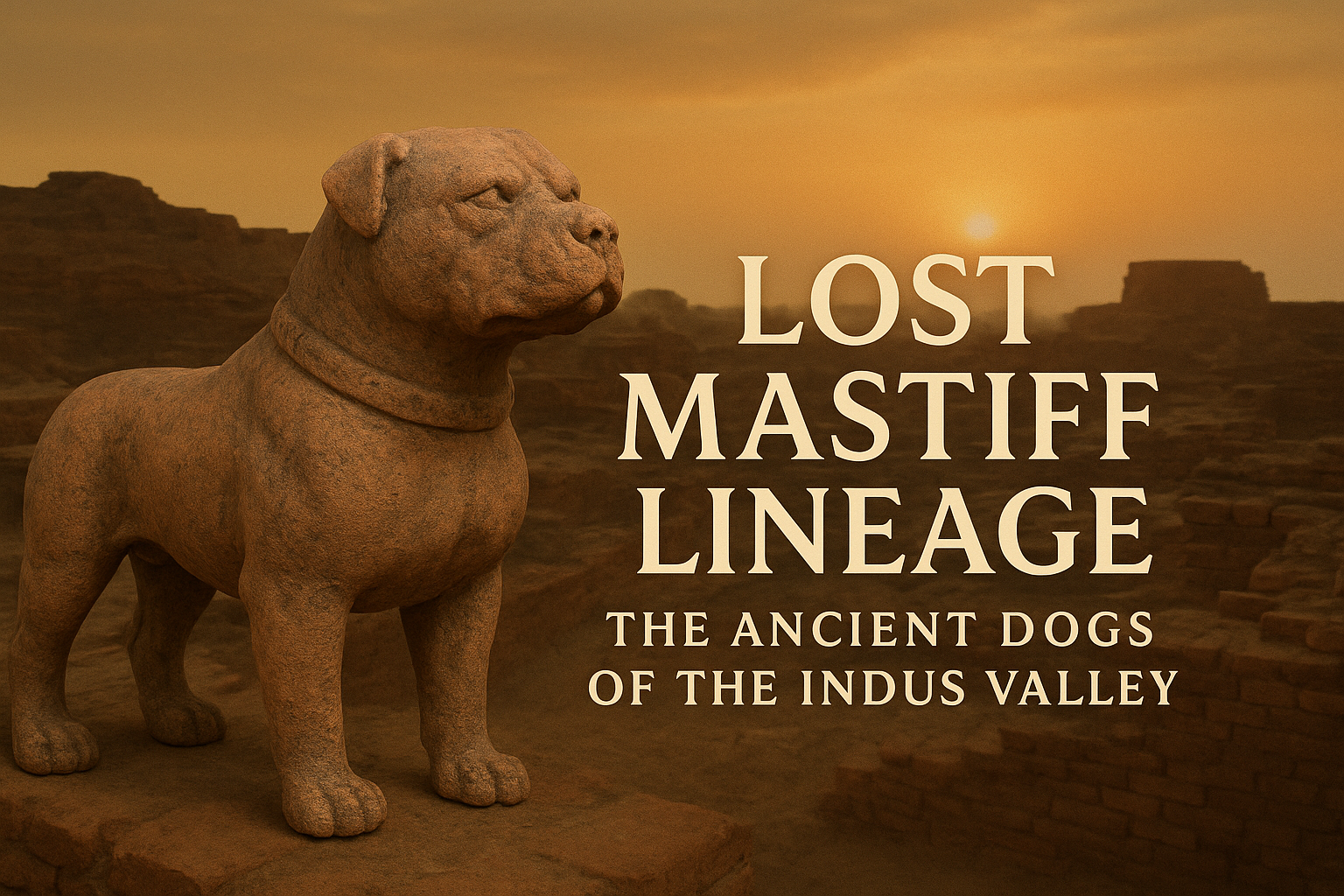
Imagine discovering that the world’s earliest mastiff-type dogs weren’t in Mesopotamia or Rome — but in an ancient city buried for millennia, where bricks and beads whisper of powerful, short-muzzled guardians. These were not just any dogs; they were the mastiffs of the Indus Valley Civilization, predating even the mighty Assyrian war dogs by more than a thousand years.
This hidden chapter of canine history isn’t just fascinating — it reshapes how we think about the lineage of giant working dogs, their role in civilization, and the deep bond between humans and their four-legged protectors.

Unearthing the Evidence: Indus Valley’s Mastiff-Type Dogs
Archaeological Bones and Terracotta Guardians
Archaeologists have found dog bones across Indus sites that strongly suggest the existence of mastiff-type dogs. According to scholars, these remains are not of sighthounds or pariah dogs — but of robust, powerful canines with broad skulls and short muzzles.
Complementing the bones are terracotta figurines discovered in Harappa and Mohenjo-Daro — tiny but telling sculptures of dogs wearing collars, with sturdy frames, lop ears, and twisted tails. These collars are more than decorative; they signal domestication and a close relationship with humans. One particularly charming piece is a figurine of a dog standing on its hind legs, begging, with its front paws raised — a testament to both artistic skill and canine personality.

Scholarly Insights: Three Ancient Types
Veteran researchers like E.J.H. Mackay identified three distinct types of dogs in the Indus Valley:
- Mastiff-like dogs — short muzzle, lop ears
- A pariah-type (local, leaner)
- A longer-faced, slender hound-type
This isn’t guesswork — these categories are grounded in bone morphology, excavation reports, and historic figurines. Some terracotta models even wear substantial collars, suggesting these mastiff-type dogs were more than wild companions; they were likely guardians or status animals.
Why These Dogs Matter — More Than Just History
- They predate Assyrian mastiffs by a millennium or more.
While Assyrian reliefs of lion hunts date to around the 7th century BCE, Indus mastiff-type dogs go back to the mature Harappan phase (c. 2600–1900 BCE). - They challenge the “Western origin” narrative of big guardian dogs.
Many assume mastiff lineages originated in Mesopotamia or Europe. But these ancient Indus dogs suggest a far more complex story — one in which the Indus Valley may have played a foundational role. - They reflect a high level of human-canine partnership.
These weren’t stray or feral animals. The presence of collars, and figurines tied to posts, hints that they were kept, bred, and valued. - They influence modern breeds.
While there’s no direct, unbroken pedigree to modern mastiffs, the traits — power, loyalty, size — echo in large working dogs of the Indian subcontinent today, like the Bully Kutta.
Historical Context: How These Mastiffs Fit Into the Bigger Picture
- Indus Valley Civilization (c. 3300–1300 BCE) was one of the world’s first urban societies. Archaeological sites like Harappa and Mohenjo-Daro have given us deep insight into daily life — including how people lived with animals.
- These craftsmen and city-dwellers didn’t just sculpt bulls and peacocks — they sculpted dogs, too. Some of the terracotta figurines are remarkably lifelike, even showing “begging” behavior or wearing beaded collars.
- Scholars also link these mastiff-type dogs to other ancient civilizations: for instance, Mackay suggested a similarity between Indus mastiffs and the mastiff-like dogs seen later in Mesopotamia, perhaps pointing to a shared or transferred lineage.
A Call to Canine Historians: What This Means Today
This is not just a dusty archaeological footnote — it’s a revolution in how we understand the history of domestic dogs.
- Can modern genetic science (ancient DNA) trace a line from these Indus mastiffs to today’s large working breeds?
- Could the spread of these dogs have followed ancient trade routes, influencing dog populations across Asia and beyond?
- What does the presence of collars and sculpted dogs tell us about the role of canines in Harappan society — as guardians, companions, even status symbols?
WHY INDUS VALLEY IS THE EARLIEST
1. Earliest Archaeological Dog Remains (Bone Evidence)
Archaeologists identified large, broad-skulled, strong-muzzled dogs in Harappan sites.
These match mastiff-type morphology better than any earlier culture.
Dating: 2500 BCE (Mature Harappan).
2. Terracotta Figurines of Mastiff-Type Dogs
Multiple Indus sites (Harappa, Mohenjo-Daro, Lothal, Kalibangan) have dog figurines:
- Thick body
- Short muzzle
- Strong neck
- Sometimes curled tails
- Some wearing collars (proves domestication)
This is 1000 years earlier than Assyrian reliefs.
3. Ancient Indian Literature Mentions Large War Dogs
Later Vedic texts (still very old: 1500–1200 BCE) refer to:
- “Heavy-bodied dogs”
- “War dogs”
- “Guard dogs tied to posts”
These descriptions continue the same lineage seen in Indus remains.
The mastiff-type is the oldest well-identified heavy dog in world archaeology.
WHAT ABOUT ASSYRIAN MASTIFFS?
People often believe the Assyrian mastiff is the oldest because of the Ashurbanipal Lion Hunt reliefs, but these are much later:
- 650 BCE — more than 1,800 years after Indus mastiffs.
Assyria had big dogs earlier as well, but no physical bones or figurines older than Indus mastiff evidence have been confirmed.
WHAT ABOUT TIBETAN MASTIFF?
The Tibetan Mastiff myth claims:
“Ancient breed 5,000 years old.”
But:
- No bones.
- No figurines.
- No clear archaeological proof before 500–1000 BCE.
So mythologically old, but not archaeologically proven older than Indus dogs.
WHAT ABOUT EGYPTIAN MASTIFF-TYPES?
Egypt had hunting and war dogs, but:
- Most were sighthound-type (Ibizan/Saluki ancestors).
- Heavier types appear only around 1500–1200 BCE.
Still much later than Indus Valley.
SUMMARY: THE CAC (Chronological Accuracy Chart)
| Dog Type / Civilization | Evidence | Date (BCE) | Notes |
| Indus Valley Mastiff-Type | Bones + Figurines | 2600–1900 BCE | Oldest proven mastiff-type in world history |
| Mesopotamian early dogs | Bones (varied) | 2000–1500 BCE | Not clearly mastiff-type |
| Egyptian heavy dogs | Art | 1500–1200 BCE | Mostly hound-like |
| Assyrian “mastiffs” | Reliefs | 650 BCE | Very late |
| Tibetan Mastiff | Myths | Not proven | No ancient remains |
The Indus Valley Civilization has the oldest archaeologically proven mastiff-type dogs in the world (c. 2600 BCE).
No other civilization has older bones, figurines, or physical remains matching mastiff morphology.
One Response