

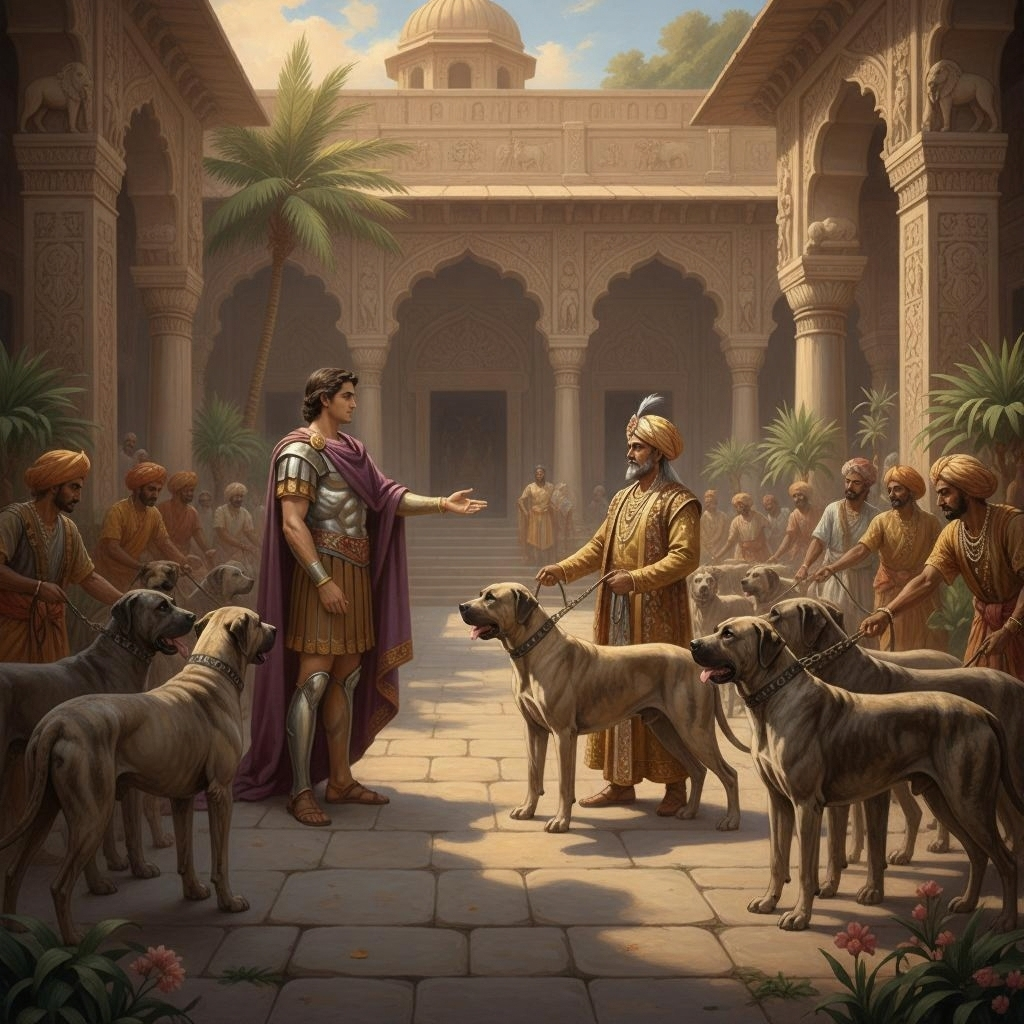
On a humid afternoon in the heart of ancient Punjab, Alexander the Great stands in the grand courtyard of his newly acquiesced ally, King Sophytes. Guards and courtiers gather, whispering in wonder. In the center, a ring has been prepared — not for dancers, not for horses, but for beasts far more potent. Sophytes, tall and regal, gestures. The handlers lead forward the first of one hundred and fifty massive dogs, their coats rippling in the sun, muscles taut and imposing. Alexander, ever the conqueror, watches with a strategist’s eye.
Then, two of the “weakest” among them are released. Into the ring charges a full-grown lion. The dogs do not flee. They stand their ground. Soon, two stronger dogs are released in support. The four begin to dominate. But just when things turn, a man brandishing a scimitar is sent in — he hacks at a dog’s leg. Guards, appalled, prepare to intervene. Sophytes coolly offers three dogs in exchange for that one. And the wounded dog, without yelp or retreat, clamps its jaws on the lion, refusing to let go — until it succumbs to blood loss.
This is no myth. It’s a story recorded by ancient chroniclers. And for dog lovers, especially those devoted to the powerful Bully Kutta / mastiff tradition of Punjab, it resonates deeply — because it suggests that the same spirit of courage, endurance, and loyalty may stretch across millennia.
1. Sophytes: The King of the Punjab
Who was Sophytes (sometimes spelled Sopeithes)? Classical sources describe him as a ruler in the Punjab region who submitted to Alexander and was allowed to retain his realm. His capital, some scholars argue, corresponded to the area of Old Bhera (in present-day Sargodha, Punjab, Pakistan), supported by archaeological traditions.
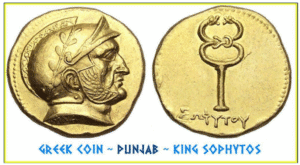
Numismatic evidence also attests to a ruler named Sophytes. Silver coins bearing his name, struck in the Greek style, survive — though exactly which Sophytes (and when) is debated Some scholars link the name Sophytes with Saubhuti, perhaps rooted in local traditions. Whatever the precise identity, his reign illustrates a powerful fusion of Hellenistic and South Asian cultures — and, crucially for our story, a deep tradition of elite, large dogs in his court.
2. Ancient Accounts of the Dogs
The primary source for the story comes from Diodorus Siculus (Library of History, Book XVII.92), who describes how Sophytes presented Alexander 150 large, courageous dogs reputed to have a “strain of tiger-blood.” According to him:
- Sophytes arranged a test: a lion was released against two of his dogs, and when they struggled, two more were added.
- As the dogs began to dominate, a man with a scimitar cut off one dog’s leg (on Sophytes’ orders).
- The wounded dog did not cry out or release; it simply died holding onto the lion.
- Alexander protested, but Sophytes insisted.,
Other sources, like Pliny, mention the remarkable size and strength of certain dogs given to Alexander — though he refers to a different context (a dog from Albania).Still, the parallels in these anecdotes help us understand how dog-loving traditions featured in Alexander’s expeditions.
3. The “Tiger-Blood” Legend — A Brindle Illusion
One of the most striking elements of the story is the claim that these dogs had “tiger blood.” To the Greek observers, unfamiliar with certain regional dog coat patterns, this must have seemed extraordinary.
From a cynologist’s perspective, this is almost certainly not literal tiger ancestry. Instead, the legend likely grew from the appearance of a brindle or striped coat — similar to the kind seen in many South Asian mastiff types, including some Bully Kutta lines. The Greeks, never having seen tigers up close in their homeland, may have interpreted the striping as something wild or exotic. In that sense, the myth reveals more about cross-cultural misunderstanding than about actual genetics. Yet, for them, believing these dogs were “tiger‑bred” made them all the more formidable — and worthy of Alexander’s attention.
4. Punjab: An Ancient Mastiff Heartland
Punjab has long been a cradle of martial and canine traditions. The region’s geography — with its plains and rivers — is well suited for hunting, guarding, and war. That Sophytes’ court would maintain a kennel of large, powerful dogs is entirely plausible in this context.
Archaeological and textual traditions place Sophytes in what is now Punjab, Pakistan, further deepening the local resonance. This suggests that the roots of modern mastiff culture in Punjab might not be purely romantic — they have real, potentially 2,300-year-old precedents.
5. From Sophytes’ Lions to Modern Bully Kutta
So, how do these ancient mastiffs connect to the Bully Kutta, the powerful Punjab dogs we know today?
- Type & Temperament: The dogs Sophytes presented were prized for courage, size, and a firm grip — traits that Bully Kuttas are still known for.
- Coat Patterns: The tiger‑blood myth potentially hints at ancient recognition of brindle striping, still common in modern lines.
- Cultural Memory: For Mastiff lovers and breeders in Punjab, the story offers a powerful ancestral narrative — one of continuity, resilience, and tradition.
- Fighting Legacy: The gripping instinct described by Diodorus (a dog refusing to release its hold) parallels documented behavior in strong mastiff-type dogs. When you watch a Bully Kutta lock in on prey (or in your video, on a lion), there’s something primordial in its courage.
6. Modern Evidence: Courage That Still Lives
As a breed authority, I regard this as powerful evidence: the same muscular strength, the same tenacity, the same grip that ancient observers marveled at may not just be legend — it lives on.
This video contains historical and working-dog content shown strictly for educational and documentary purposes. It does not promote animal harm, cruelty, or staged fighting in any form. The footage is presented to illustrate the traditional working capacity, temperament, and physical strength associated with the Bully Kutta breed. Viewer discretion is advised.
7. Why This Matters to Mastiff Lovers
- Heritage & Pride: Knowing that the mastiffs of Punjab may descend (culturally, if not genetically) from dogs that Alexander himself saw inspires a deep pride.
- Breeding Ethos: If the courage and grip of ancient mastiffs were so celebrated, modern breeders have a powerful legacy to honor — not just in strength, but in training, temperament, and ethical breeding.
- Cultural Reconnection: For Pakistani mastiff enthusiasts, this is more than dog history — it’s regional history, tying into a shared civilization that spans thousands of years.
- Educational Value: Sharing this story helps newcomers understand Bully Kutta not just as a “fighting dog,” but as a symbol of ancient martial tradition.
8. Sidebars
Sidebar A: How the Greeks Described These Dogs — and What Biologically They Might Have Been
- Size & strength: “remarkable for their size and courage.”
- Temperament: able to face a lion, persistent grip, immense endurance
- Coat legend: “tiger strain” likely refers to brindle‑striped coats, misinterpreted as tiger blood by Greek observers unfamiliar with such patterns.
Sidebar B: From Sophytes to Bully Kutta — Mastiff Traits That Persist Today
- Broad, powerful head with strong jaws
- Deep chest, muscular shoulders
- Courage under pressure — not easily intimidated
- High pain tolerance / strong grip instinct
- Coat variations, including brindle (striped) or solid colors
- Guarding, defending, and loyalty instincts
9. Conclusion: A 3,000-Year Legacy Standing Tall
When we talk about Bully Kutta today, we’re not just talking about a powerful dog breed — we’re recalling an ancient legacy. The story of King Sophytes giving Alexander 150 formidable mastiff-type dogs is more than a historical curiosity. It’s a cultural mirror.
It reminds us that in the plains of Punjab, thousands of years ago, people valued not just strength, but heart. They bred dogs for courage, for loyalty, for tenacity. And when those dogs locked their jaws on a lion — unyielding even to death — they carved their place not just in myth, but in history.
For modern mastiff lovers in Punjab, every Bully Kutta that stands its ground is a living link to that epic past. The video of a Bully Kutta gripping a lion is more than dramatic — it is a testament that the courageous spirit of those ancient canines still walks beside us.