

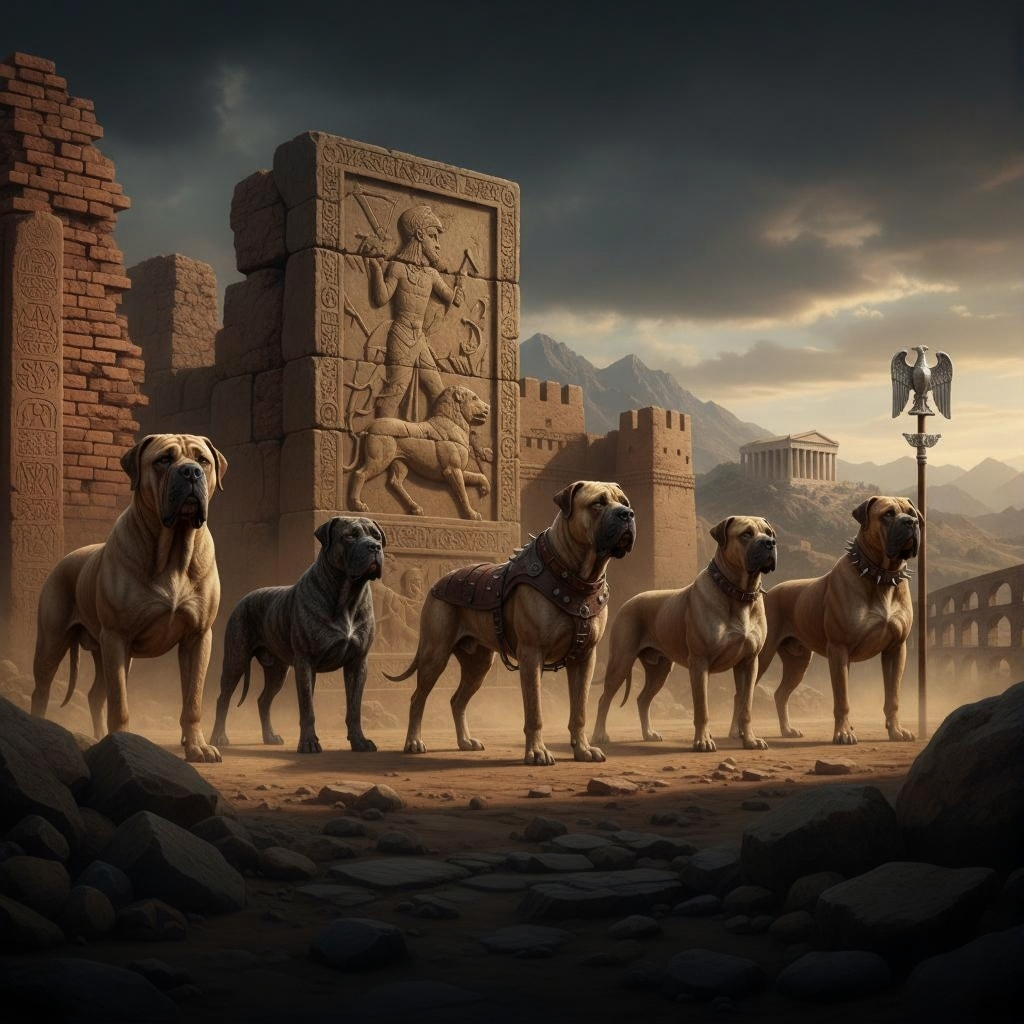
Imagine a king’s cloak snagged by a broad muzzle at the edge of a campfire. The metal glint of spear-heads, the low rumble of thousands of feet, and among them—hundreds, perhaps thousands—of dogs: not curs nor lap-animals, but deep-chested, bone-heavy animals bred for hauling, hunting and holding. A clerk in Herodotus’s time could not count them; a later Roman poet would call them “fighting dogs.” Across three millennia, many civilizations kept such dogs close to their hearts and to their spears. This article follows those canines—Indus terracotta shadows, Assyrian lion-hunters, Hyrcanian hounds, Molossians, Alaunts, Roman canes pugnaces—tracing the archaeology, the classical testimony, and the living echoes of an ancient functional type we now call “mastiff.”
I. Defining the ancient “mastiff” — type, not breed
Before cataloguing names, we must be precise. Ancient writers did not breed by kennel standard; they recognised types—dogs for chasing, catching, holding, guarding. When a Greek or Persian calls a dog “large,” “lion-fighting” or “from Hyrcania,” they describe function and form, not a fixed pedigree. Modern cynology maps these descriptions onto the molosser/mastiff family: heavy heads, broad chests, powerful necks, high grip drive. This article treats “mastiff-type” as a recurring functional archetype that appears across many cultures, sometimes continuing as living landraces and sometimes vanishing into myth.
Sources for this article include the surviving classical texts (Herodotus, Diodorus Siculus, Ctesias, Aelian, Pliny, Strabo, Oppian), archaeological syntheses of dog remains (Indus Valley and Mesopotamia), and modern historical syntheses of mastiff-type dogs and their diffusion. Quotations and key passages are cited directly to allow readers to consult the primary witness.
II. Indus-Valley mastiff-type (c. 3000–1500 BCE): clay, bone, and early functional form
Archaeology provides our earliest tangible hints. Harappan sites have yielded terracotta canine figurines and osteological assemblages that suggest more than a single pariah dog. In some contexts the morphology—robust limb bones, wide muzzles—indicates dogs capable of strength work: guarding settlements, assisting hunts, pulling loads. A careful modern study of ancient Indian dog descriptions and material culture concludes that Indus people kept several kinds of dogs, some matching what we might label “mastiff-type” in function and form (see Bollée, Gone to the Dogs in Ancient India).
Interpretation: the Indus evidence does not produce a named “breed,” but it does document a long continuity of large, utilitarian dogs in South Asia—an important datum for arguments that large Indian dogs contributed to later regional mastiff traditions.
III. Mesopotamian and Assyrian mastiffs (c. 2nd–1st millennium BCE): lions, reliefs, and royal sport
Assyrian palace reliefs—stone tableaux of kings on hunts—are among the clearest visual documents of ancient mastiff-type dogs. Reliefs from Nineveh and Nimrud show dogs locked on lions, dragging or subduing prey while human hunters flank the scene. These are not small hounds but weighty dogs depicted in action. The archaeological record is complemented by Near Eastern textual evidence that places mastiff-like dogs at the center of royal hunts.
Why it matters: the Assyrian motif—dogs as instruments of royal prestige and practical power—codifies the mastiff’s social role: in palace life and in spectacle, these dogs were both tools and symbols.
IV. Hyrcanian dogs and Persian kennels (Achaemenid era; 6th–5th centuries BCE)
Classical sources record Persian kings’ fondness for hounds. Herodotus’s famous aside—that Xerxes’s army contained an innumerable host of “Indian hounds” (κυνῶν Ἰνδικῶν)—is revealing not only for the dogs’ presence in a military context but for the implication that dogs were part of imperial logistics and display (Herodotus, Histories 7.187). Persian hunting practices, as described by later encyclopaedic treatments of Iranian culture, show royal kennels stocked with selected hounds (see Encyclopaedia Iranica entry on Persian hunting).
Hyrcania, the Caspian-adjacent region, was famous for its big game and for hounds bred to confront boar and lion. Classical geographers and natural historians (Strabo, Pliny) call attention to Hyrcanian dogs’ size and prowess—descriptions consistent with the molosser type.
V. Classical attestations in the Greek imagination: Ctesias, Diodorus, Aelian
From the Greek vantage, India, Persia and the east were lands of marvels. Some of the most evocative classical references connect directly to mastiff-type dogs:
-
Ctesias (via Photius) reports that Indian dogs were “very large and even attack lions” (Ctesias, Indica, fragment preserved in Photius). This extraordinary image—of dogs confronting lions—resonated across later retellings and suggests that Greek/Persian informants perceived Indian canines as exceptional.
-
Diodorus Siculus records the famous episode of King Sophytes (Soeithes) presenting 150 large dogs to Alexander; two were tested against a lion, then reinforcements joined—the dogs prevailed until a handler hacked off a dog’s leg, after which the wounded dog held on to the lion until death (Diodorus, Library of History 17.92). This tale emphasizes grip, tenacity and courage—traits at the heart of mastiff-type behavior.
-
Aelian and Pliny, in their compendia of natural and wondrous facts, collect anecdotes of giant eastern dogs, reinforcing the classical view of powerful dogs emanating from the east.
These textual witnesses, while sometimes marbled with marvel and second-hand reporting, create a recurrent classical motif: the east (India, Persia, Hyrcania) as a source of large, formidable dogs.
VI. The Molossus and Epirus: the Greek molosser archetype (c. 1st millennium BCE)
The Molossus, from Epirus, becomes the canonical classical molosser. Authors from Aristotle to Virgil mention Molossian dogs—used for guarding and for heavy hunting. Molossian dogs carried a specific social cachet: they were tied to tribal identity (the Molossians) and to aristocratic usage. In Hellenistic military contexts, Molossian dogs acquired legendary status; later Roman writers link the Molossus to large Italian and Iberian mastiff derivatives.
Functionally, the Molossus represents the European branch of mastiff-type morphology: broad-headed, robust, and used for guard and battlefield support.
VII. Alaunt (Aulant) and the steppe route of diffusion
The Alaunt (also written Aulant/Alaunt) is better thought of as a family of types associated with nomadic steppe peoples—often linked to the Alans. Historical records show Alaunt subtypes: sighthound-like Alaunts for chasing, catch-dog Alaunts for subduing, and heavier Alaunts for guarding. As steppe peoples moved westward, Alaunt-derived types intermingled with local stocks, seeding medieval European mastiff varieties. The Alaunt thus functions as a major conduit in the transcontinental diffusion of mastiff traits.
VIII. Sicilian war dogs and Roman Canis Pugnax (Mediterranean axis)
Ancient Mediterranean authors (Oppian, Grattius, and later Roman compilers) celebrate Sicilian war dogs—short-muzzled, muscular, and used both in hunts and in battle. Under Roman adoption these dogs became known as canes pugnaces, the “fighting dogs” of the legions and the arenas. The Roman pugnax shows how the mastiff-type was appropriated into state military and entertainment apparatuses, and how the Mediterranean branch of mastiff evolution influenced later European breeds (for example, Italian mastiff types).
IX. Near Eastern landraces and living continuity: Kurdish, Sarabi, Tibetan mastiffs
Not all ancient mastiffs died with the empires that bred them. Living landraces in mountainous and pastoral regions preserve many molosser features: the Kurdish mastiff (variously named Pshdar or Assyrian shepherd), the Sarabi of Iran, and the Tibetan Mastiff on the high plateau. While genetic continuity is complex and rarely linear, morphological and functional continuity—the use of large dogs to guard flocks and property—links these modern landraces to their ancient counterparts.
Archaeology and ethnography: skeletal comparisons and old photographs suggest these dogs have long histories in their regions, offering researchers living material to compare with iconography and classical description.
X. Synthesis: lines of evidence, strengths and limits
Three independent strands buttress our reconstruction of ancient mastiff-type dogs:
-
Material culture (archaeology): Harappan terracottas and canine bones; Assyrian reliefs; osteological remains provide hard morphology and contextual function. (See Bollée’s archaeological synthesis on ancient Indian dogs; Assyrian relief catalogues in museum corpora.)
-
Classical testimony (Greek, Roman, Persian): Herodotus’s logistical aside (Xerxes’ Indian hounds), Diodorus’s Sophytes episode, Ctesias’s Indica fragment, Pliny’s natural history—these texts repeatedly associate the east with exceptionally large dogs. Each text has transmission caveats, but their convergence is persuasive.
-
Living landrace continuity and medieval diffusion: Alaunt migrations, Anatolian and Sicilian stocks, and surviving guardians of the Near East and Himalaya offer morphological parallels and social continuities.
Limitations: we must not overclaim direct, unbroken genetic descent from, say, Indus terracotta dog to modern English Mastiff. Ancient “mastiffs” are best treated as an enduring functional type that recurs and spreads with human migration, trade, conquest and cultural prestige.
XI. Selected quotations (primary witnesses)
-
Herodotus: “nor again of … the Indian hounds, which accompanied it, could any one state the number, by reason of their multitude.” (Histories 7.187).
-
Diodorus Siculus, recounting Sophytes’ gift to Alexander: a test against a lion with dogs holding until death (Diodorus, Library of History 17.92).
-
Ctesias (via Photius): “The Indian dogs are very large and even attack lions.” (Indica, fragment).
These passages illustrate the contemporary perception of eastern dogs as exceptional in size and fortitude.
XII. Conclusion — why the mastiff’s story matters
Mastiff-type dogs are a living archaeology of human needs and values: they guarded thresholds, held prey, accompanied hunts, and signalled status. Across empires—Indus citadels, Assyrian palaces, Persian hunting parks, Hellenistic camps, Roman arenas—humans and molossers worked together. The trail from clay figurine to museum relief to the modern mastiff shows continuity not just of form, but of relationship: people shaping dogs to meet their material and symbolic needs.
Future research directions should be explicitly interdisciplinary: ancient DNA analyses of archaeological dog remains, comparative osteology, and a renewed philological study of classical dog-references could move the field from persuasive convergence to stronger causal demonstration. For now, the mosaic of text, bone and living dog invites both wonder and careful scholarship. The mastiff, in all its regional guises, remains among humanity’s oldest and most durable collaborators.